
Garbage Mountain
(hey it's drew)

This past July, I planned a stoop sale in Carroll Gardens, Brooklyn, for a Saturday in the middle of the month. After eight years of holding intermittent stoop sales, this was the anticlimactic finale which appeared as the others but acted as a bookend to dealing with my inheritance from my mother who died eight years ago. When she died, she left me a storage space large enough to fit ten cars, crowded full of items she hoarded over her lifetime. The items varied in type, style and value: from the elementary school homework she completed in the 50s, to furniture from her career as an antiques dealer in the 90s, she’d saved everything.
Almost every summer since, I’ve held one or several stoop sales to sell items as I feel prepared to release them. These sales are an excuse to socialize with with passers by or friends who visit me on the stoop. I met one of my closest friends, Jim, at one sale when he bought a weathered red church pew six years ago.
My remaining cache of items was enough for one last sale. I aspired to sell my things as well -- clothing I never wore, my father’s tiny old Japanese tea set I told myself I’d some day use but never did, crystals from my embarrassing crystals phase (I was taking a lot of acid), tarnished vintage mirrors, and a wooden sculpture of a penis.
The week before the sale, I received multiple weather warnings of a heat wave predicted to occur the same day. Suspecting this was a bad omen, I contemplated canceling. I dreaded babysitting a bunch of dusty junk all day, sweating and alone. I preferred to spend the day with my friends, doing anything in the company of people I cared about.
I feared that the friends I invited would arrive, observe what I was charging money for, and view me as an insane bag lady with poor judgment. I worried my collection of junk reflected poorly upon my value as a person. I had no utilitarian use for these items. They occupied physical space in storage and psychic space in my mind; I felt responsible for them yet craved freedom from that responsibility. I knew from the success of past sales other people would want the items, but they’d become symbolic of garbage to me. I also harbor an eternal suspicion that those I love will realize they’ve mistakenly invested time with someone who sucks and will end our friendship.
When I expressed to my friends that I wanted to cancel the sale due to the heat, they all said the same thing: I’m coming to hang out with you, don’t cancel it.
Rather than dragging them out in shame, I committed to arranging the items outside with a false sense of pride to make them seem more valuable. Katherine, who left some clothing in my storage space when she moved out of New York, visited me. She decided to sell most of the clothing at the sale. My friend Jim planned to add some of his handmade benches. I hoped my bullshit would look better by proximity to their curated and respectable wares.

The evening before, Katherine and I packed my Jeep: a shoebox rattling with costume jewelry, a brown lamp shaped like a cross, a ghoulish, textured painting of a woman emerging from a dark void. Four chandeliers that needed rewiring. A small dresser my mother had painted her signature color of green and stenciled with a thin vine of morning glories above the top drawer. We stored the items in Lindsay’s hallway.
In front of Lindsay’s apartment, we set things out on the curb: we hung clothes on a rack and positioned a hideous, two foot tall blue and chrome antique clock in the street so it was visible to people driving by.
I took pictures of the sale, and posted it on the neighborhood Facebook group: vintage clothing, art, home goods, and a wooden sculpture of a penis. I provided the cross streets.
Within the first hour, one woman bought all the crystals to give to her son as a gift from the tooth fairy. I sold a brown side table made from adjoined vintage wine boxes, and the small green dresser. A neighbor bought a marble lamp without a lamp shade. Shoppers complimented my items; this is better than a vintage store, someone said. I felt optimistic and validated. Jim set out his benches. By the time four other friends arrived, a man pulled up in his car and jumped out urgently.
You still have the wooden penis? Cars honked at him.
Two dollars.
It’s for my friend. He gave me a twenty.
I only have $8. So if you want it, its $12.
I think it’s worth $12.
He took his wooden penis and drove away.
When I ended the sale, I left the unsold items on the street like a half picked over skeleton; I knew people would take them for free. I went to dinner with my friends.
At dinner I sat with five friends, most of whom previously didn’t know one another. I hadn’t expected them to show up or stay all day; I thought my invitation to a garbage sale might be boring. Making myself available facilitated an opportunity to spend time together. If I chose to engage the narrative that I wasn’t valuable, and that my friends might lose interest in me, there would have been no sale, no dinner, and nothing to show up to — no chance for things to be different.

During sorting episodes in the past, lasting anywhere from a few days to several weeks, I struggled to understand what was valuable, or how to measure and quantify that value. Now, I understood what I wanted and discard; I valued my connections to the outside world more than items belonging to the deceased. My parents’ most valuable gift was that of their time -- days spent together, often with nothing notable occurring, the long unfolding of our relationship, their intangible lessons about the importance of kindness and curiosity.
In Knut Hamsun’s Hunger, a book about an impoverished writer starving in Oslo, the delirious protagonist spirals into a manic frenzy of self destruction:
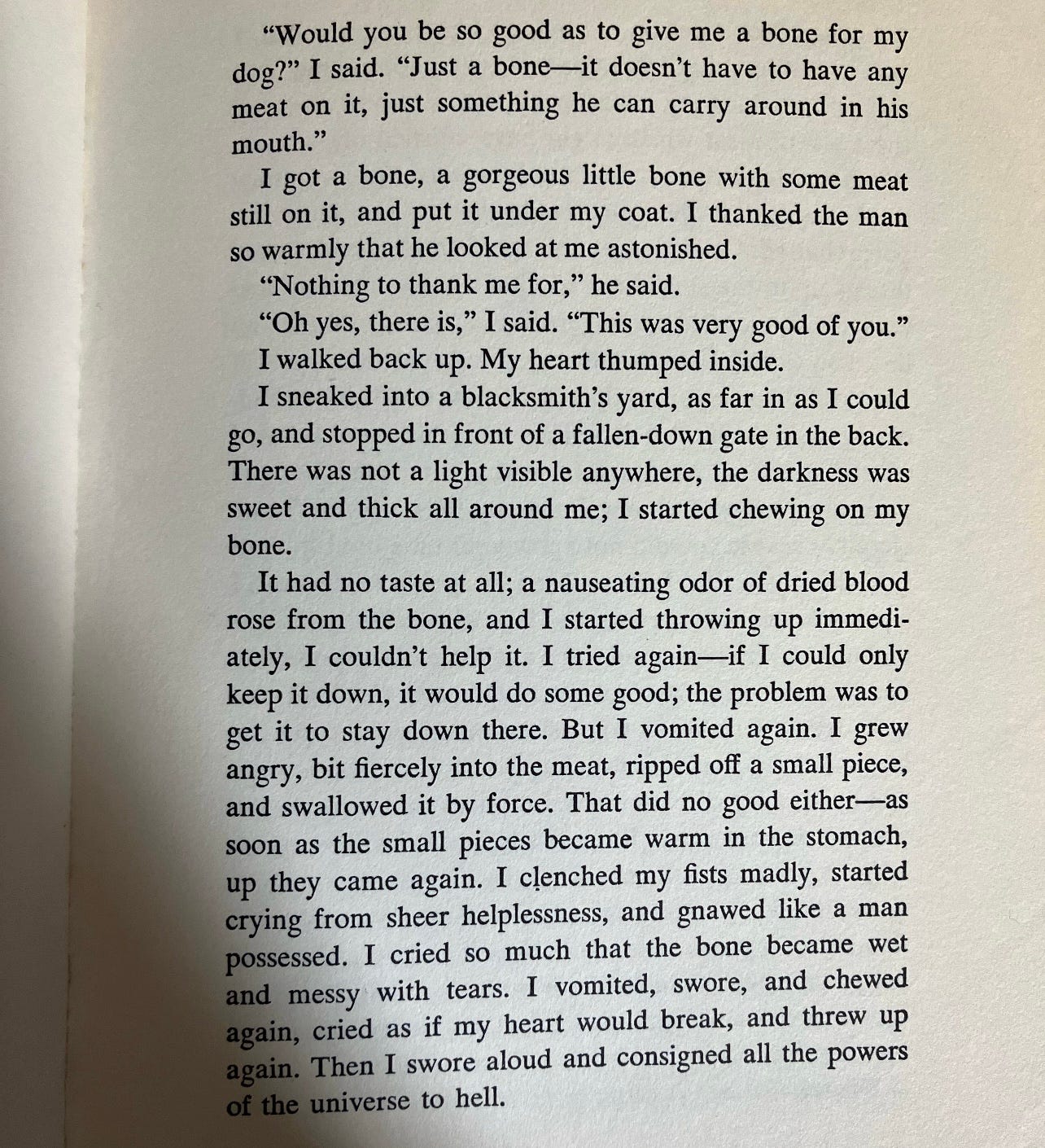
The passage, funny and sad in its absurdity, made me feel seen. I forced myself to digest my old pain, telling myself something harmful would heal me and suffering a wild devastation the opposite transpired. My own self destructive cycle: I saved things to review ‘later on,’ without knowing when I would do this or what I hoped to gain from doing so.
Hoarding was only recognized as a mental illness by the DSM in 2013, something which now helps me understand how my mother processed (or didn’t) the trauma of my father’s death -- after which her hoarding worsened exponentially. My mother’s proclivity for codependent relationships manifested with my father and myself — and with her pets, who tethered her to home on a strict feeding schedule. And with her own emotionally abusive mother, who repeatedly abandoned her by reasserting her inability to telegraph the love or care my mother never stopped seeking. And particularly with her things, incapable of abandoning her.
My relationship to my mother’s items was complicated by two facts: she rarely permitted me in her storage space; like many hoarders, she was paranoid that someone — even me, though she literally trusted me with her life as I took her to doctors appointments and was responsible for dispensing her medication — might steal or damage something. Her protectiveness imbued her stuff with an almost mystical quality.
Secondly, the items were disordered, indiscriminately packed: I found my father’s journals in a suitcase of parking tickets from the 90s. My grandmother’s death certificate was sandwiched between two random sketches of shrimp. If I hired a clean out team to remove everything, I’d lose windows into my parents’ history. I wanted to sift these out in anticipation of a time when I had enough spatial and emotional distance from their deaths to be curious about their lives.
—-
Three years after her death, I entered one of many ‘purge periods.’ With a friend’s help, I hauled items to the curb hoping someone would take them for free (they did). I archived discarded items in my journal:
Leather upholstered chair, shredded by cats / Collection of crowbars / Beanie babies / Crooked red dresser / Porcelain figures painted by my father (in prison?) / Rusty sewing machine / Enamel tabletops, no legs / Crooked yellow dresser / Three buckets of rusted metal doorknobs / Thirty house doors
I can’t recall a single revelatory moment when my relationship to the items changed, but I recall many moments of friendship when I felt supported, the slow construction of life I built without completely understanding what I was doing, only that I was moving towards hope.
While reflecting on changes in my attitude towards these items, I spoke with my friend Jim. He quoted Foucault’s essay on heterotopia, which he defined as “a self contained place that has rules which only exist in that world.” I remembered rules I invented to justify hoarding seven broken lamps in storage; I believed closure was defined as fixing the lamps that belonged to my mother, that I could approximate healing once every item was used for its intended purpose — the lamps giving light, in a home.
There is a profound moment in Bam Margera’s 2003 movie, Haggard, that I frequently return to when contemplating change. Ryan Dunn’s recent ex-girlfriend Glauren is cutting Dunn’s hair while explaining her need to break away from their relationship.
You know what your problem is? she says, holding scissors suspended in mid air, you always want shit to stay the same. In the movie’s final scene, the change in Dunn’s life -- his unwanted breakup -- benefits him in a profound way he previously couldn’t have anticipated. I had the capacity to change, if not yet the ability.
When my mother died, she had three friends; I did not expect to see the 50+ people who attended her funeral. Someone in the neighborhood saw her name on the plaque outside the funeral home, and told others who knew her but fell out of touch. People I had never seen approached me, telling me how my mother touched their lives by some act of friendship or kindness. Multiple people said they’d contacted her in her last years; she never responded.
While sorting her things for the sale, I found an old scrap of my mother’s diary among the loose art and costume jewelry. I want to die, she’d wrote in elegant cursive on faded and lined yellow paper. The entry, dated several years before I was born, expounded her feelings of loneliness and isolation.
I remembered when I’d read her journals and cry. But the journal resonated with me differently than it had several years ago, when I was closer to my mother’s death and isolated myself in the same way she had after my father’s death. I found the entry a little melodramatic. I understood it expressed a very human sentiment I’d also expressed -- if not the compulsion to die, a reductive expression of desire to cease hurting.
I was only able to recognize my mother’s self-isolation and struggle with addiction from an eight year distance from her death. Though my struggles had paralleled hers for some time, I’d since built a life full of connections and meaningful relationships. And honestly, I laughed. Maybe I could imagine her somewhere laughing too, because I finally understood something I’d prevented myself from accessing before -- life’s complex absurdity, the way we manifest the things we are most afraid of.
The tragedy of my mother’s life was her inability to experience the love surrounding her.
At dinner, someone proposed a toast to the sale’s success. In reflecting on what my mother couldn’t see towards the end of her life, and what I could that night surrounded by my friends, I redirected the sentiment: no matter how much money I made, if it weren’t for you guys, the sale wouldn’t have been successful.

This is so beautiful, thank you for sharing. Hoarding is an all too common condition, many of our loved ones are affected and it is very difficult for the children of hoarders to process. There is always the trauma at its heart, and I commend the heart you have brought to this piece. Thank you.
So boldly and honestly written Drew. Brought tears to my eyes which blurred the words but I could not cease reading alongside the flow of what you’ve expressed here. Every time I read something of yours about your life, it’s so palpably and incredibly apparent the insights you’ve gained and the power over language and structure that you have. I am eternally sad for your mothers passing, yet eternally respectful of how honestly and fully you have handled this tragedy and how you’ve been able to transport so much the pain into these creative and expressive outlets, continuing to share not only her possessions, but your words on everything. Sifting through the contents from someone so deeply close to you who had the illness of hoarding is devastating and debilitating, as well as having had to live alongside. Describing the magnitude and the mystique of her belongings gives such a texture to anyone who wouldn’t have known you personally, and adds such a poignant context to what I already knew. And then expressing so clearly the deep plummeting fears of being unwanted and let go of.. tremendously done. I’ve always been in awe of your bravery, since far before your mothers passing, and you express vulnerability in such a relatable and strong way. Thank you for sharing this and all you share ❤️